People trust you to be attentive and take good care of their loved ones. Learn how to highlight your experience and qualifications as a carer and find your next role by viewing a downloadable carer CV example and four tips.
Ensure your CV layout is structured to best highlight your unique experience and life situation.
Text Format
PERSONAL STATEMENT
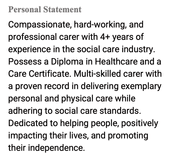
Compassionate, hard-working, and professional care worker with 4+ years of experience in the social care industry. Possess a Diploma in Healthcare and a Care Certificate. Multi-skilled carer with a proven record in delivering exemplary personal and physical care while adhering to social care standards. Dedicated to helping people, positively impacting their lives, and promoting their independence.
EDUCATION AND CERTIFICATIONS
City College Norwich, Sep 2016–Oct 2017
Health and Social Care Diploma (Level 2),
First Aid Certification (renewed in 2020)
Care Certificate (2019)
Norwich High School for Girls, Norwich, Sep 2009–June 2016
A-Levels: Business Studies (B), History (C), Maths (B)
GCSEs: 10 A*–C, including English, Maths, and ICT
WORK EXPERIENCE
Magic Life, Norwich
Resident Care Assistant, April 2020–Present
Help all patients in their daily routines during rounds and administer their medications with 100% accuracy
Update 56+ medical records such as bloodwork and progress notes in a timely manner
Offer support and care for 13 adults with autism and Alzheimer’s disease
Facilitate 6+ events a week such as recreational activities and art classes
Provide high standard personal care and cleanliness for the elderly, resulting in a 100% rating
Work closely with 3 doctors, 2 managers, and 2 care assistants to deliver standard personal care and support to patients
At Home Carer, King’s Lynn
Private Carer, February 2017–April 2020
Delivered at-home care for an elderly patient through an individualised care plan
Provided helpful daily living support such as preparing meals, feeding, bathing, toileting, and ambulation
Administered 5+ medications and set up 2 medical appointments a week
Coordinated daily phone and video calls for the patient and their 4 family members
Achievements
Maintained 100% clean driving record while accompanying and transporting patients
Trained 5 new carers to provide high-quality service
Increased punctuality by 70% by implementing timesheets and daily attendance records
ADDITIONAL SKILLS
Bilingual, fluent in English and French
Experience with live-in care and one-to-one social care
First Aid and CPR certified
Excellent verbal and written communication skills
HOBBIES AND INTERESTS
Volunteering at rescue dog shelters
Knitting
Photography
How to write a carer CV
Before you begin writing, make sure you know how to write a CV in a way that best emphasises your strengths.
When you apply for a job in the caring profession, you need more than just experience to impress your employers. Writing a professional carer CV plays an important role in showing employers your strong work ethic, compassion, and patience for looking after others.
Here are four CV writing tips to help you create a successful carer CV:
1. List your top carer skills
Carers provide assistance and look after vulnerable people such as the elderly in addition to people with disabilities or illnesses. So you need to write an effective carer CV showing you’ve got the right mix of key skills for your CV and experience to make a significant difference to the clients you’re helping.
First, emphasise the hard skills (also known as technical skills) on your CV. These are the skills you’ve learned during your training or work experience which make you good at caring for vulnerable populations.
For example, listing your background or knowledge in medical care tells a recruiter you’re handling capable of day-to-day tasks as well as emergency medical situations.
Also, include your technology skills since many patients and facilities use software and technology for keeping patient records and coordinating appointments.
Here are other technical skills for your carer CV:
Video conferencing software (e.g., Zoom, FaceTime)
Additionally, don’t forget to mention your carer soft skills. These natural abilities indicate how you interact with your colleagues and patients.
For instance, employers seek compassionate carers who give patients their full attention and patience. So list your active listening skills and communication skills to show you’re perceptive and responsive to your patient’s needs.
These are carer soft skills employers often look for:
Adaptability
Coordination skills
Empathy
Monitoring skills and observation
Patience
People skills
Service orientation
Social perceptiveness
Teaching skills
And make sure to highlight all your carer skills by providing specific examples of how you applied these skills in your carer CV’s work experience section.
You can also mention relevant certificates and training you completed, such as your Care Certificate, diplomas in healthcare and social care, or other equivalent National Vocational Qualifications (NVQs).
Here are other helpful certifications for carers:
First aid certificates
English language certification (if English isn’t your first language)
Driving licence
2. Write a concise personal statement
Employers or recruiters don’t have time to read all the information in the dozens of CVs submitted to them. So capture their attention at the beginning by opening your CV with a strong CV personal statement.
A carer CV personal statement consists of 2–4 sentences and summarises your top strengths and qualifications as a carer.
Your personal statement sits at the top of your CV and includes the following:
Here’s an example of a CV personal statement for a carer job:
Include hard numbers and your relevant qualifications in your carer CV.
3. Customise your CV to the job description
A generic CV that doesn’t adhere to specific requests in the job listing will likely be rejected. So take the time to:
read the job post and follow the instructions carefully
include relevant information that matches what the employer is looking for
be honest when writing your CV
For example, if the employer is looking for a carer for a disabled adult, listing your past work in sales may be irrelevant.
But if you’ve had a previous childminder role, take advantage of that experience in your carer CV by highlighting your ability to help children with daily challenges such as eating, dressing, and maintaining personal hygiene standards.
4. Include carer-related keywords in your CV
There are two main reasons why you should identify and add keywords to your CV.
First, relevant keywords capture an employer’s attention. Using keywords directly from the job description shows that your CV is tailor-made for the role and you have the necessary qualifications.
Second, adding keywords is useful when the recruiter uses an applicant tracking system (ATS) to filter candidates for the job. Using keywords that match the job description increases the chances of your carer CV passing the screening stage and receiving an interview.
Here’s a list of commonly used terms in the caregiver industry:
Bathing
Caregiver
Care worker
Communication skills
CPR
Customer service
Elderly care
English speaking
First aid
Home care
Nursing
Personal shopping
Psychology
Support worker
Other Great CVs & Cover Letters from this Industry:
Our coders and HR experts are proud to introduce our new Free CV Builder software to help you earn more interviews in the UK's competitive job market. We provide HR-approved CV templates, built-in job description bullet point phrases to select, and simple export to MS Word and PDF.