Writing your first CV after graduating from university can be difficult. Improve your graduate CV by viewing our downloadable example and writing tips below.
Ensure your CV layout is structured to best highlight your unique experience and life situation.
Text Format
PERSONAL STATEMENT
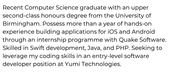
Recent Computer Science graduate with an upper second-class honours degree from the University of Birmingham. Possess more than a year of hands-on experience building applications for iOS and Android through an internship programme with Quake Software. Skilled in Swift development, Java, and PHP. Seeking to leverage my coding skills to obtain an entry-level software developer position at Yumi Technologies.
University of Birmingham (2019–2022) BSc (Hons) Computer Science
Relevant Modules: Algorithmics, Systems Programming, Professional Software Development, Advanced Networks and Operating Systems
Trinity High School and Sixth Form Centre, Redditch (2014–2018)
A-Levels: Maths (A), Sciences (A), Computer Science (A) GCSEs: 10 A–C including Maths, Government and Politics, Sciences, and Geography
WORK EXPERIENCE
Blast Interactive, Birmingham Software Engineering Intern, February 2022 – present
Used Swift to develop an iOS app to help renters find available flats across the UK
Work with the development team to improve the debugging process
Wrote a new interface to manage backup log data using Java and Python
Fix bugs in current apps, leading to an 8% reduction in user complaints
Age UK, Birmingham Volunteer, May 2019 – April 2021
Helped the elderly develop computer literacy
Guided more than 10 clients daily to set up email and social media accounts
Assisted the office in setting up a new filing system, improving response time by 5 minutes on average
HOBBIES
Avid cyclist, regularly participating in regional races
Amateur viola player
Dedicated golfer
REFERENCES
Dr Nicole Teenman
Professor of Computer Science
University of Birmingham
32 Castle Road
Birmingham
B36 9JX
07325 963 852 [email protected]
Relationship: Dr Teenman was my Computer Science professor.
Brad Pittance
Head Software Engineer
Blast Interactive
14 Teapot Lane
Birmingham
B23 7SJ
07654 741 863 [email protected]
Relationship: Mr Pittance is my manager at Blast Interactive.
How to write a graduate CV
Before you begin writing, make sure you know how to write a CV in a way that best emphasises your strengths.
Putting together a strong job application as a recent graduate is tough because it’s difficult to impress employers when you have little or no work experience.
To get a good position after graduating from university, you need to know how to write a graduate CV that properly displays your qualifications and experience.
We’ll help you do just that by explaining exactly how to write a great graduate CV, section-by-section:
1. Add your contact information
In your CV’s header, tell employers how to contact you. You can write a great CV, but without any contact information employers won’t be able to reach you about potential job offers or interviews.
There’s no need to get creative with this bit. Simply list your:
name
phone number (mobile is preferred)
location
professional email address
LinkedIn profile URL (if you have one)
2. Write a personal statement
A personal statement is a brief paragraph located at the top of your CV that explains to employers who you are, what your qualifications are (with examples for context), and why you’re interested in the position.
Writing a convincing graduate CV personal statement is essential to your job search because it’s a chance to explain why you’re passionate about the role or a particular career path. This passion can help make up for a lack of formal work experience and win over employers by showing them you’d be a dedicated employee.
Spend a little time thinking about what to say, as you don’t want to sound too generic. Remember, a personal statement is valuable, as it’s the first thing a recruiter sees on your CV.
Here’s an example of a graduate CV personal statement that’ll grab the target employer’s attention:
Keep your graduate CV personal statement short to ensure the recruiter reads all of it.
In fact, as a recent graduate, you likely have more skills to list on your CV than you might think. You can develop valuable hard and soft abilities by working on course projects, volunteering, and participating in extracurricular activities (such as being the leader of a university club).
Here are some examples of hard and soft skills that you’ve probably picked up throughout university:
If you have little or no work experience, your education section should be the most robust part of your CV. You can use this section to prove why you’re qualified for the job.
For your qualifications, include your:
university name
degree
degree classification (Hons)
relevant modules
dates attended
A-Levels and GCSEs
Because you’ll likely have taken around 10 GCSEs, you only need to abbreviate them — for instance, as:
‘GCSEs: 10 including Maths and English’
Most employers will, at a minimum, want to know you’ve acquired GCSEs in Maths and English. This leaves more room for your A-Levels, which are what really count.
Here’s an example of a properly formatted education section on a graduate CV:
King’s College London (2019–2022) BSc (Hons) Geography — upper second-class honours
Relevant Modules: World Geography, Sustainable Development, Extreme Climates, Geographies of the Anthropocene, Water Governance and Management, Land Surveying A-Levels: English (A), Maths (A), Geography (A) GCSEs: 10 A–C, including Maths & English
5. Include relevant work experience
When including your prior work experience on your CV, don’t make the mistake of thinking you can only include experience from previous jobs.
Relevant experience acquired while doing work placements, voluntary work, or even taking part in competitions such as Young Enterprise is also great to include and shows employers that you have crossover skills.
For each role you list, include the:
company or organisation
dates of employment
position title
bullet points summarising your responsibilities, key achievements, and skills developed
Below is an example of a good graduate CV work experience entry:
You can put volunteer jobs and internships in your graduate CV’s work experience section.
6. References
Finally, include a section for references at the bottom of your graduate CV. Usually, putting two references on your CV is ideal: one academic referee and one prior work referee.
Especially if you have minimal work experience, references can confirm some of your positive traits and further convince employers that you’d make a strong addition to their company.
Example of a reference on a graduate CV
Dr Nicole Teenman
Professor of Computer Science
University of Birmingham
32 Castle Road
Birmingham
B36 9JX
07325 963 852 [email protected]
Relationship: Dr Teenman was my Computer Science professor.
Unless specifically told otherwise in the job posting’s requirements, you can choose to either include your reference’s contact details or not. If you’re not including your references’ contact information, be sure to write ‘available upon request’ so that employers know you’re willing to provide the information later.
Professional CV Builder
Our coders and HR experts are proud to introduce our new Free CV Builder software to help you earn more interviews in the UK's competitive job market. We provide HR-approved CV templates, built-in job description bullet point phrases to select, and simple export to MS Word and PDF.