You have the typing speed, organisational skills, and personality to make a great receptionist, but do you know how to write a receptionist CV? Use our professional writing tips and free example below as a guide for writing a standout CV for a receptionist role.
Ensure your CV layout is structured to best highlight your unique experience and life situation.
Text Format
PERSONAL STATEMENT
Customer-focused Receptionist with 5+ years of experience working in the public and private sectors. Adept at efficiently handling challenging clients, demonstrating excellent telephone and customer service skills, as well as presenting quality work. Skilled communicator with the ability to develop strong relationships with clients and set them at ease. Instrumental in maintaining records, handling multi-line phone systems, and database management with 100% accuracy.
EDUCATION
University of Central Lancashire, Preston (2014–2017) BA (Hons) Business Management, upper second-class honours (2:1)
Relevant Modules: Management Research and Analysis, Managing in the Digital Workplace, Operations and Supply Chain Management, Leadership in Organisations, Strategic Management
Dissertation Topic: Implementation of Effective Sales Strategies
Longbenton Comprehensive School, Lancaster (2006–2013) A-Levels: Maths (A), French (A), English Literature (A)
GCSEs: 10 A–C including Maths, English, Combined Science, and IT
WORK EXPERIENCE
Salient Accounting & Finance, Basildon Receptionist, December 2020–Present
Handle multi-line phone system, operate telephone switchboard, and manage and update client database with the required information
Greet 17+ guests per day at the check-in desk with a friendly smile, provide necessary paperwork, and update system records
Organise appointments using a telephone and email appointment scheduling system for a team of 6+ managers
Maintain executive managers’ calendars by planning and scheduling conferences and making travel arrangements
Implemented a new CRM and reporting system, reducing costs by 30% whilst improving productivity by 25%
Manage 120+ phone calls daily with 0 complaints in the last 3 years
HM Estates Limited, Oxford Receptionist, May 2017–November 2020
Warmly greeted people entering the facility by determining their purpose of visit and escorting them to appropriate staff
Maintained logbooks, including sign-in logs, front desk expenditures, and received calls
Restructured office scheduling and record management system, improving accuracy by 27%
Ensured maximum client satisfaction, achieving a 90% customer satisfaction score
KEY SKILLS
Expert organisational and time management skills
Technically proficient in MS Office (Word, Excel, PowerPoint, and Outlook)
Bilingual, fluent in French and English
Excellent interpersonal skills
Conflict resolution
Office supply management
Solid typing skills: (75 WPM)
Multi-line phone call systems
HOBBIES & INTERESTS
Travelling
Reading
Watching classic films
Cooking for friends and family
How to write a receptionist CV
Before you begin writing, make sure you know how to write a CV in a way that best emphasises your strengths.
Talented receptionists are essential to the healthy functioning of any office, so employers can be selective about who they hire as receptionists.
But to be invited in for an interview, you’ll need a CV that quickly demonstrates your qualifications, experience, and relevant skills.
To help you get started, here are three expert tips for writing an outstanding receptionist CV:
1. Use the receptionist job description’s keywords in your CV
With so much competition for well-paying administrative positions in the UK, you want your CV to show employers that you have all the qualifications they want in a receptionist.
One of the best ways to effectively make your CV is to carefully read and use the job description directly from their advert. Employers often list all the keywords related to the qualities, skills, and experience they’re looking for in a receptionist. So by using these same keywords in your CV, you can demonstrate what a perfect fit you are for the job.
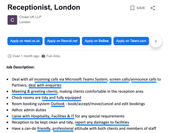
Here’s an example of a receptionist job description from a job advert, with keywords underlined in blue:
Use several of the same keywords from the job advert to enhance your receptionist CV.
All of these phrases give a clear picture of what the employer wants to see on a receptionist applicant’s CV, so your job now is to incorporate them into your work history section.
Here’s how a receptionist applicant tailored their work experience bullet points according to the job description:
Write 4–6 descriptive bulleted points to supplement your receptionist CV.
This example is effective because the candidate mentions both the technical abillities (like Microsoft Teams System, Outlook) and soft skills (for example, friendly, professional, communication skills) required for the role.
A hiring manager looking at this work experience section will see that the candidate is a good match for the role, with the relevant skills and experience to work well in an office setting.
2. Quantify your receptionist CV with relevant examples
Receptionists handle multiple tasks in an office, so employers will look for evidence that you can successfully complete all of your daily tasks.
So in your CV as a receptionist, highlight significant numbers and achievements that demonstrate the impact you made on your colleagues and clients in previous roles.
Quantifying your CV with descriptive examples will:
show employers a clear picture of your abilities
provide evidence of the value you bring to a receptionist role
give you some potential talking points during an interview
Wondering how or when to quantify your receptionist experience? Here are times when you should use numbers on your receptionist CV:
5 ways to quantify your receptionist CV
Describe the size of the organization you worked for: Mentioning the number of employees or departments you supported will give employers insight into your previous responsibilities.
List the volume of calls and visitors you handled: Specifying the number of calls or visitors you greeted on a daily or weekly basis demonstrates your multitasking and interpersonal abilities.
Mention performance metrics: Were you responsible for maintaining a log of appointments, meetings, or messages? If so, include the number of appointments you scheduled or messages so employers know you can prioritise tasks and work efficiently.
Write about any customer service improvements: If you were part of a team that implemented a new system or process that improved customer relations, listing the percentage increase in customer satisfaction shows your contributions to the company’s success.
Note the events and meetings you coordinated: If you were responsible for taking meeting minutes or planning office gatherings, showcase your time management abilities by mentioning the number of events or meetings you organised.
Including these quantifiable examples provides concrete evidence of your abilities and achievements that prove you’d be a great receptionist for your target company.
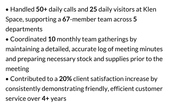
To help you get an even clearer idea, here’s a bulleted list example from a receptionist applicant that highlights all the points we mentioned using bolded numbers:
Use powerful action verbs to start each of your receptionist CV’s bulleted points.
3. Take advantage of upskilling opportunities
Whether you’re an experienced or new receptionist in the UK, continuously improving your CV skillset will help you stay competitive in the job market.
By taking on more upskilling opportunities and adding them to your CV’s abilities section, you’ll not only improve your current skills, but also demonstrate your commitment to professional development to potential employers.
Here are some ways you can make yourself a valuable candidate:
How to improve your chances of being hired as a receptionist
Focus on technology: Technical skills are highly important for the modern workplace, so stay up-to-date with the latest tools and software used by receptionists. Consider taking online courses on LinkedIn Learning or Coursera or even attending workshops to learn about software such as Microsoft Office, Customer Relationship Management (CRM) systems, and appointment scheduling software.
Understand how to use basic office equipment: Research the types of office equipment that are commonly used in receptionist roles, such as printers, fax machines, and telephone systems. If these office tools are new to you, watch online tutorials and videos that’ll help you learn how to use them.
Develop your communication skills: Communication-focused abilities are critical for success as a receptionist, so consider taking courses or workshops that focus on communication, such as public speaking or business writing.
Show you’re an organised worker: Receptionists are often tasked with managing a busy front desk and handling multiple tasks at once, so mentioning your organisational skills can help you work more efficiently and effectively. Learning and then listing your knowledge of tools like Trello or Google Drive in your CV will help you succeed as a receptionist.
Gain experience in customer service: Providing top-notch customer service is a key aspect of a receptionist’s role. Consider taking free or paid courses or workshops that focus on interacting with others, such as communication and customer service or conflict management and then add them to your CV’s introduction, skills section, or work experience section.
Other Great CVs & Cover Letters from this Industry:
Our coders and HR experts are proud to introduce our new Free CV Builder software to help you earn more interviews in the UK's competitive job market. We provide HR-approved CV templates, built-in job description bullet point phrases to select, and simple export to MS Word and PDF.