Here's everything you need to know about making a CV skills section, including 6 writing tips and examples of different places to put your skills section on a CV, depending on your needs.
A skills section on a CV is usually the next to last section (right before your hobbies and interests), but don’t let that position fool you. A well-written skills section can help make your CV stand out to recruiters, boosting your chances of landing an interview.
To help you make the best skills section for your CV, we have:
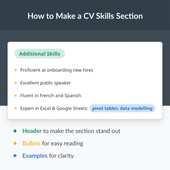
Here’s an example that shows how to write a good CV that includes an effective CV skills section:
Format your skills section properly to ensure employers can easily find and read it.
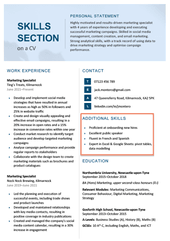
And below is the same skills section in context on a CV. If you like how this skills section looks, you can download the entire CV outline as a Word document, or copy the text version template below into your writing program:
Highly motivated and results-driven marketing specialist with 4 years of experience developing and executing successful marketing campaigns. Skilled in social media management, content creation, and email marketing. Strong analytical skills, with a track record of using data to drive marketing strategy and optimise campaign performance.
WORK EXPERIENCE
Marketing Specialist Ting’s Treats, Kilmarnock June 2021–Present
Develop and implement social media strategies that have resulted in annual increases as high as 50% in followers and 25% in website traffic
Create and design visually appealing and effective email campaigns, resulting in a 20% increase in open rates and a 15% increase in conversion rates within one year
Conduct market research to identify target audience and develop targeted marketing campaigns
Analyse campaign performance and provide regular reports to stakeholders
Collaborate with the design team to create marketing materials such as brochures and product catalogues
Marketing Specialist Nock Nock Brewing, Kilmarnock June 2019–June 2021
Led the planning and execution of successful events, including trade shows and product launches
Developed and maintained relationships with key media contacts, resulting in positive coverage in industry publications
Created and managed the company’s social media content calendar, resulting in a 30% increase in engagement
Marketing Intern House of Fraser, Glasgow October 2018–June 2019
Assisted in the planning and execution of marketing campaigns, including email, social media, and events
Created and edited marketing materials such as brochures, presentations, and website content
Conducted market research to inform campaign strategy and target audience
Assisted in the development and maintenance of the company’s social media presence
Analysed campaign performance and provided regular reports to stakeholders
ADDITIONAL SKILLS
Proficient at onboarding new hires
Excellent public speaker
Fluent in French and Spanish
Expert in Excel & Google Sheets: pivot tables, data modelling
EDUCATION
Northumbria University, Newcastle-upon-Tyne September 2015–October 2018 BA (Hons) Marketing, upper second–class honours (ll.i)
Relevant Modules: Marketing Communications, Consumer Behaviour, Digital Marketing, Marketing Strategy
Gosforth High School, Newcastle-upon-Tyne September 2013–October 2015
A-Levels: Business Studies (A), History (B), Maths (B) GCSEs: 10 A*-C, including English, Maths, and ICT
HOBBIES & INTERESTS
Ukulele playing
Pub quizzes
Attending science-fiction conventions
6 tips for how to write your CV skills section (with examples)
Follow these 6 tips to ensure your skills section catches the eye of a busy recruiter:
1. Identify your relevant skills
Many applicants just list whatever skills come to mind in their skills section to fill out their CVs, but doing so is a mistake. Your job application is your introduction to an employer, so you should optimise every aspect of it — including your skills section — to make the best impression possible.
To optimise your CV’s skills section, you need to:
study the job advert to determine the skills the employer wants to see on your CV
review your professional and personal background to find the skills you have that match the employer’s needs
list your relevant skills in your skills section
Even if you’re applying for a specific role, the preferred skills for that role will change from company to company. So rewrite your skills section for every job application you submit to show employers you want their open position in particular.
2. Properly format your CV skills section
The proper format for a CV’s skills section depends on whether you’re writing a:
standard CV (for highlighting job-relevant work experience)
Here’s how to lay out a standard CV skills section that stands out to employers:
Create a section header
Clearly label your skills section with a header. You can use bolding, extra-large text, and all capital letters to make your header stand out, but just make sure it matches the rest of the headers on your CV.
Common header titles include:
Skills
Additional Skills
Key Skills
Relevant Skills
Make a bulleted list of your skills
Use bullets to list your skills and make it easy for the recruiter to read them. Below is an example of a skills list with bullets, and one without bullets. Notice how the bulleted list appears more organised and is easier to read without missing anything:
Easy-to-read CV skills section (bulleted)
Microsoft Office (Word, PowerPoint, Excel)
Google Analytics (GA4)
CRM software expertise (Salesforce, Hubspot)
Native-level French and Polish speaker
Hard-to-read CV skills section (no bullets)
Microsoft Office (Word, PowerPoint, Excel), Google Analytics (GA4), CRM software expertise (Salesforce, Hubspot), native-level French and Polish speaker
Use headers within your list (optional)
If you break up your skills into categories, bold each category to make the section more organised. These examples show you how bolding headers within your skills list improves readability:
Bolded headers (easy to read)
Technical: Advanced coder (HTML, Java)
Communication: Engaging public speaker, experienced meeting leader
A CV written to focus on skills over work experience is useful for applicants without relevant job experience — either because they recently graduated or are changing careers. This type of CV skills section includes:
your skills listed as section headers
bulleted descriptions under each header
Here’s an example of how to format a skills based CV’s skills section:
Communication Skills
Lead weekly group project meetings for 3 different classes and present project updates to lecturers and classmates
Write 5+ clear and concise research papers per semester
Conducted 23 mock market research interviews and analysed findings for a marketing course assignment
Microsoft Office Skills
Create class presentations using Excel and PowerPoint
Designed 3 mock sales decks and other marketing materials using Word and PowerPoint
Managed and tracked project timelines using Excel
3. List an appropriate amount of skills
Your skills section should have at least 2 skills listed to keep it from looking empty. There’s no limit to how many skills you can list, but use your best judgement — for example, if your traditional CV’s skills list takes up a full page, it’s unlikely that the employer will read through it all, which means it’s too long.
But if you’re writing a skills based CV, your skills section can be one page or longer because it’s structured with section headers and bullets for easy skimming.
4. Include both hard and soft skills
Your skills list should include both hard and soft skills to show employers that you’re a well-rounded applicant who can handle technical and interpersonal tasks.
Here’s an example CV skills section that includes both types of skills:
Relevant Skills
Expert-level Adobe Photoshop and Premiere user
Award-winning oil painter
Detail-oriented image editor
Fast-learning team player
5. Provide specific examples
Whenever possible, provide specific examples of the skills in your list to give the recruiter a clear picture of what you can do:
Clear CV skills section with examples
Carpentry techniques: Veneering, scrolling, moulding, and framing
Power tool expertise: Drills, table saws, routers, and sanders
Unclear CV skills section without examples
Carpentry
Power tools
When you write a skills based CV, your skills section should feature more in-depth examples and hard numbers for context. Here’s an example skills section entry from a career changer’s skills based CV:
Analytical and Problem Solving Skills
Analysed market trends and customer feedback to inform business strategies, leading to a 45% increase in revenue
Developed creative solutions to complex problems, resulting in a 20% increase in efficiency
Conducted data analysis and prepared 4 reports each quarter to support decision-making processes
6. Use consistent grammar
When you write your CV skills section, use the same grammatical structure throughout your list (this is known as parallelism). For instance, if you start one bullet with an adjective (e.g., ‘Fluent’), start every bullet with an adjective.
Smooth-flowing CV skills section with consistent grammar
Experienced in WordPress
Proficient at Microsoft Office
Fluent in Spanish
Disjointed CV skills section with varied grammar
WordPress experience
Microsoft Office
Native-level Spanish speaker
Examples of different places to put a skills section on a CV
Typically, the skills section is placed towards the end on a properly structured CV. However, you can move it higher if you want to emphasise your skills over other information. Also, some well-designed CV templates neatly fit the skills section onto the first page in a sidebar to increase the chances it’s seen alongside your CV’s personal statement and work experience.
Here are examples of various places to put a skills section on a CV:
Skills section on the last page
In standard UK CV formatting, the skills section goes on the last page, like this:
If you’re applying for a position that requires several specific skills, you may want to move your skills section above your relevant work experience to emphasise your technical expertise on your CV. Here’s an example of a CV skills section on the first page of a CV for web developer work:
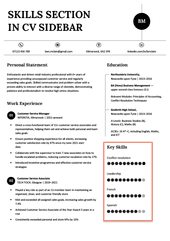
Some CV templates are designed to fit the skills section on the first page in a sidebar next to the work experience section. Here’s an example of a creative CV template with a skills section in a sidebar:
Here’s an example of how to show your skills level with certain keywords (bolded below) and examples (italicised below):
Key Skills
Proven classroom management skills, resulting in zero behavioral incidents in the past 3 years
Advanced education technology skills, hosting monthly software/hardware workshops for other teachers
Conversational Spanish skills, enabling clearer communication with parents
And this example CV skills section uses skills bubbles to visually represent that applicant’s proficiency:
2. Is it OK to not put skills on a CV?
No, it isn’t OK to not put skills on a CV. Even if you fully described your skills in the rest of your CV sections, you should always include a dedicated section that summarises the top strengths on your CV. Doing so ensures the employer notices your best abilities even if they just skim through your CV for a few seconds.
3. What skills shouldn’t I list on my CV?
Skills you shouldn’t list on your CV include abilities that are:
totally irrelevant to your target position
controversial, like target shooting and political activity (but you can list these skills if you’re targeting industries that require them)
outdated (e.g., joined-up handwriting and VCR repair)