If you're applying for a competitive job, you need a standout cover letter to get an interview. Scroll down for a cover letter example and 20 expert tips that will show you how to write and format a cover letter effectively.
A header, including your information, the contact person’s information, and the date
A professional greeting, ideally “Dear Mr/Ms/Mx Surname”
Body paragraphs outlining your relevant qualifications and enthusiasm for the job
A final call-to-action paragraph thanking the employer and requesting an interview
A sign off using a professional closing such as “Yours sincerely” followed by your signature and typed name.
Here’s an example of a standout cover letter
A successful cover letter effectively argues why the applicant should progress to the next stage of the recruitment process.
You should show the employer why you’re the best choice for the specific position — and not just provide an overview of your work experience and skills.
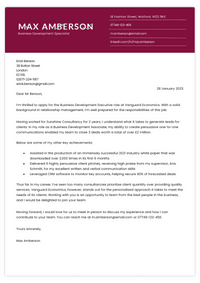
Here’s an example of a cover letter that got it right and convinced the employer that the applicant deserved a job interview:
Erick Benson 38 Bolton Street London E2 E9L 02071-234-567 [email protected]
28 January 2023
Dear Mr Benson,
I’m thrilled to apply for the Business Development Executive role at Vanguard Economics. With a solid background in relationship management, I’m well prepared for the responsibilities of this job.
Having worked for Sunshine Consultancy for 2 years, I understand what it takes to generate leads for clients. In my role as a Business Development Associate, my ability to create persuasive one-to-one communications enabled my team to close 3 deals worth a total of over £2 million.
Below are some of my other key achievements:
Assisted in the production of an immensely successful 2021 industry white paper that was downloaded over 2,000 times in its first 6 months
Delivered 6 highly persuasive client pitches, receiving high praise from my supervisor, Ana Schmitt, for my excellent written and verbal communication skills
Leveraged CRM software to monitor key accounts, helping secure 90% of forecasted deals
Thus far in my career, I’ve seen too many consultancies prioritise client quantity over providing quality services. Vanguard Economics, however, stands out for the personalised approach it takes to meet the needs of its clients. Working with you is an opportunity to learn from the best people in the business, and I would be delighted to join your team.
Moving forward, I would love for us to meet in person to discuss my experience and how I can contribute to your team. You can reach me at [email protected] or 07749-123-456.
20 cover letter tips for a standout job application
Here are 20 tips on writing a job-winning cover letter:
1. Make a new cover letter for every application
Sending one cover letter for all your applications doesn’t help you stand out. In fact, generic cover letters can hurt your job application.
Employers want to see that you’ve put some thought into your application. So create a new cover letter that addresses the specific job requirements for every position you apply for.
2. Research your target company
To determine what to write for your cover letter, research the company. Your research should answer the following questions:
What are the company’s goals?
What does the job involve?
What kind of candidate is the company seeking?
How do you fit the company’s culture?
3. Read cover letter samples for inspiration
If you’re still unsure how to begin writing, read industry-appropriate cover letter examples and look at the best cover letter examples of 2023 for inspiration on what to include in your cover letter.
4. Find the proper tone
Your cover letter’s tone depends on your industry and experience level:
Creatives: Use a playful, upbeat tone to express your creativity
Traditional professionals (e.g., lawyers, business analysts): Write in a straightforward, serious style to show your professionalism (similar to writing a letter of resignation)
Educators: Be eloquent, articulate, and concise to demonstrate your mastery of communication
Experienced applicants: Use powerful, straightforward language to show your leadership abilities
Inexperienced candidates: Focus on your relevant training and skills if you’re new to the job world (or writing a cover letter for a career change) to emphasise the ways your career goals match the target position
5. Craft a catchy opening paragraph
Employers usually decide within a few sentences whether to skip over your cover letter or continue reading it. Therefore, you’ve got to learn how to make a strong start to your cover letter.
To determine what will best catch the reader’s attention, consider your audience:
If the company culture is laid-back, use tasteful humour or passion to show your personality
If the company culture is formal, open by describing how your experience and skills will benefit the employer or talk about your top accomplishments
Here’s an example of a catchy opening paragraph for a laid-back company:
If you’re like most people, you saw the Boots pharmacist advert that aired last Christmas. I’m the person who pitched the idea for that advert — and that’s just one of the many reasons why I’m certain I’d enhance your creative team.
Here’s an example of a catchy opening paragraph for a formal company:
As the sales manager for Xtreme Ltd., I’ve created and implemented strategies that have increased revenue by £50,000 and grown our clientele by 23% within 2 years. I’d like to replicate this success at BuyGoods Ltd.
6. Explain what motivated you to apply for the job
When faced with two similar applicants, employers will always choose the applicant who is more enthusiastic about working for their organisation.
Therefore, it’s essential that you clearly demonstrate your motivations for applying in your cover letter.
Use one paragraph of your cover letter to explain why you want to work for the employer and are the best fit for the position.
There are several ways you can explain your motivations for applying. Here are a few ideas to get you started:
An interest in the company culture
Sharing company values
Eagerness to work in the company’s industry or sector
Appreciation of company products, services, or achievements
The desire to progress in a specific role
The best job applicants relate their experience to their knowledge of the hiring company.
Rather than just listing your daily responsibilities at your previous job, use hard numbers and examples to give the recruiter a better understanding of your skills and achievements.
Here are two examples of cover letter statements that are bad at first, but jump off the page when context is added:
Bad
Helped students score higher in their A-Levels to increase their prospects
Good
Developed and implemented a Chemistry curriculum that produced a 97% A-Level pass rate for 2 consecutive years
Created content strategies that reduced our bounce rate by 42% and kept our website at number 1 on Google’s search engine results page (SERP) for 6 consecutive months
9. Don’t use clichés
Cover letter clichés don’t work because:
they’re vague and don’t show the recruiter what makes you unique
the recruiter can misinterpret them as a disguise for your lack of experience
Rewrite overused phrases like:
I think outside the box
I’m solution-driven
I’m detail-oriented
I’m a go-getter
I think I’m a perfect fit for this job
I’m highly motivated
I work well under pressure
The above phrases don’t demonstrate how you’ve applied your skills. If you want to highlight attention to detail, the ability to work under pressure, or similar core skills, use relevant examples to display your best traits.
10. Close with a call to action
Request an interview at the end of your letter to:
show the recruiter you’re passionate, committed, and ready for the next phase
indicate you can take initiative
demonstrate confidence and assertiveness — qualities employers value
If you’d like to know more about my skills and achievements, please contact me at [email protected] or on 07412 345 678.
11. Proofread
Spelling, punctuation, grammar, and formatting mistakes make you appear sloppy. To avoid embarrassing errors:
read your cover letter out loud to find mistakes you missed before
ask a friend to proofread
edit to make sure that your proofreader didn’t make new mistakes
use online programs like Grammarly, Hemingway App, and ProWritingAid to spot errors and improve your writing’s quality (remember to switch these tools to British English)
12. Limit your cover letter to one page
Your cover letter length should have 250–450 words spread across 3–4 paragraphs and fit on one side of A4. A longer cover letter will be time-consuming to read and could be misinterpreted as a sign of poor communication.
The harder your cover letter is to read, the more likely the employer will put your application in the bin.
Optimise your covering letter by using UK-standard margins and line spacing:
Margins: 1.27–2.5 cm
Line spacing: 1–1.5 spaces
If you apply non-standard margins and spacing, your cover letter will either have too much white space or be overstuffed with text. Either way, you’ll come off as unprofessional to your target employer.
15. Feature your name in a cover letter header
Make your cover letter stand out by putting your name and contact information in a cover letter heading.
Here’s how to format your header:
Write your name in a large, bold font
Put your contact information directly under your name in a smaller font
Write each element of your contact information on a new line using single-line spacing, or write them on a single line separated by vertical bars or slashes
Centre- or right-align your header
Write the date on the first line under your header in the DD/MM/YY format (for example, 5 January 2023)
Quality cover letter templates have preformatted headers that will help you save time. Some templates even include a splash of colour in their headers to attract the employer’s attention.
16. Left-align the employer’s contact information
Format the employer’s contact information as you would if you were writing it on an envelope.
Write your contact’s name, company address, phone number, and email address in a left-aligned, single-spaced list.
17. Start with a professional greeting
Your cover letter’s greeting is a great place to show that you’ve done your research and tailored your application to the position. If you know the contact person by name, use:
Use bullet points to highlight your qualifications without taking up too much space. Bullets draw the recruiter’s eyes and make your cover letter easy for the employer to quickly scan to see if you’re a good fit for the role.
19. Pick an appropriate sign-off
The correct ways to sign off your cover letter are:
‘Yours sincerely,’ if you’ve addressed the contact person by name
‘Yours faithfully,’ if you addressed a job position or department in your greeting
20. Sign your name — and format it correctly
If you’re sending a digital copy of your cover letter, press ‘Enter’ twice to create a line of empty space after your sign-off, and then type your name.
When you send your cover letter by mail or submit it in person, leave 3–4 lines after your sign-off before typing your name. Sign your name in the resulting blank space.
Frequently asked questions about writing a standout cover letter
Still unsure of how to write a convincing cover letter? Here are three questions commonly asked about writing an effective cover letter for a job:
One thing you should never do with cover letters is send the same cover letter to multiple employers.
The purpose of a cover letter is to explain why you’re the best candidate for a specific job — not just dress up your CV.
Tailor your cover letter to the specific job requirements of the position you’re seeking by carefully reviewing the job advert, company website, and the company’s social media handles.
In addition to telling the employer why you’re qualified to work for them, your cover letter should answer one of the following questions:
Why are you interested in the specific company or its brands, products, or services?
What would your career goals be if you got the job?
What benefits can you bring to the hiring team?
How are your values and the company’s values related?
2. How do you show enthusiasm in a cover letter?
Here are two ways to show enthusiasm in a cover letter.
1. Demonstrate knowledge of the company
Demonstrate your knowledge of the company by mentioning company values, products, or the industry in which the company operates.
Showing the employer that you understand their organisation and are motivated to work with them shows that you’ve thought carefully about the opportunity and will take your future responsibilities seriously. Furthermore, discussing your interest in the company tells the employer that your cover letter was written for them and them alone.
2. Write in an active, engaging voice
Phrases like ‘responsible for’ and ‘tasked with’ are dull and make you appear to lack confidence. Use the active voice (e.g., ‘I oversaw’ instead of ‘I was responsible for’) to show the employer you can take initiative and work independently.
Similarly, be careful about underselling yourself with modest language. Phrases like ‘got to grips with’ or ‘wrapped my head around’ shrink your achievements and don’t inspire confidence in the employer.
Take a look at the difference word choice makes to these almost identical cover letter paragraphs:
At DevSparks, I supervised a team of 15 people to deliver marketing campaigns with budgets reaching £500,000. In the 3 years I held this role, I demonstrated an outstanding ability to develop plans for complex, 6–12-month projects.
At DevSparks, I was responsible for a marketing team that delivered marketing campaigns with budgets reaching £500,000. In the 3 years I held this role, I got to grips with developing plans for complex, 6–12-month projects.
3. How do I make my cover letter stand out with no experience?
Writing a 250–400 word cover letter without any work experience might seem intimidating. However, there are several ways you can convince the employer you’re qualified to do the job.
1. Emphasise relevant skills. If you’re a recent graduate, focus on your education or other formal qualifications. If changing careers, focus on your transferable skills, work ethic, and any unique benefits you can bring to the hiring team.
2. Offer potential solutions. Explain how you can help the company address any challenges or goals mentioned in the job advert or other company media. E.g., if the company is expanding into a foreign market, highlight any relevant language skills or cultural knowledge you possess.
3. Relate distant experience to the job. Your success as a regional sales specialist may be useful for that entry-level journalist position. Emphasise achievements that used relevant soft skills like time management, data analysis, and research to show you would be asset to the team.
More FAQs about writing your job application
Here are the answers to even more questions you might have about your job application: