

If you’re a student or an entry-level job hunter with under five years of experience, you may wonder how to write a good CV when you don’t have much professional experience.
While a two-page CV is expected from experienced individuals, you’ll gain more attention from recruiters by writing a more condensed version of your CV rather than trying to unnecessarily stretch out job-irrelevant information to fill up two pages.
Below we explain when it’s best to use a one page CV and provide some helpful one page CV templates.
What is a one pager CV?
A one page CV is a brief document highlighting your skills, experience, and education. Its purpose is to provide a concise and targeted overview of your qualifications to employers, requiring you to be very selective in which details you include.
If you’re a job hunter with little to no experience, it’s important to understand how writing a one page CV can benefit you. Hiring managers often receive a large number of applications for each job opening, so a CV with one page can help you stand out by quickly and clearly presenting your most relevant qualifications.
When is a one page CV enough?
Making a one page CV is suitable for certain groups of job hunters, including:
- school-leavers
- students
- new graduates applying for entry-level roles
Additionally, this CV format can also work for candidates with less than 5 years of experience. However, if you have more than 5 years of experience, this CV might not provide enough detail to effectively showcase your skills and experience as they’re required in the UK.
If you’re writing a school leaver CV, keeping your qualifications to one page can help highlight your relevant skills and achievements, because you’re not filling your CV up with less relevant details.
With a one-page layout, you can succinctly emphasise information that’s relevant to the position you’re applying for. You’ll also show potential employers that you can present your strengths and position yourself as a strong and capable candidate.
How to write a one-page CV
Now that you know what a one-page CV is and when to use it, let’s learn how to write one. We’ll provide you with four actionable tips to help you stand out by making the most of your CV’s limited page real estate.
1. Select a professional CV layout
When writing a CV with one page, you’ll need to select a professional and clean layout. Avoid using fancy fonts, graphics, or overly elaborate designs that can distract from the content. To make the layout easy to read and look polished, make sure you’re using:
- An easy-to-read font (preferably a serif or sans serif font)
- An appropriate font size (between 10-12 points)
- Appropriate titles for your headings
- Visually-pleasing spacing (1.27-2.5cm margins and 1-1.5 line spacing)
2. Stick to job-essential information only
With only one page to work with, it’s critical to stick to job-essential information only.
This means you should read the job description carefully to tailor your CV and focus on your most relevant experience and skills. Leave out anything that isn’t directly relevant to the job you’re applying for, and you’ll frame yourself as an ideal candidate.
For example, if you’re applying for a marketing role, you should highlight your experiences in campaign creation, your proficiency with social media platforms, and your understanding of analytics.
You’ll need to take into consideration the following elements to tailor your CV in a way that positions you as the ideal candidate:
- The job requirements and qualifications
- Your ability to perform the role’s tasks as stated in the job advert (key skills)
- The organisation’s culture
- The organisation’s mission and values
In addition to the job advert, you can find the rest of this information on the organisation’s website and social media accounts. Browse through the sections often titled ‘About’, ‘Our Mission and Values’ and ‘In the news’ to get a better overview of what the job may be like.
Identify which skills, experience, values, and working style overlap with theirs and emphasise these not only in your work experience section but all throughout your CV to make the most of the limited space.
3. Provide context with concrete examples and numbers
When you include information about your experience and skills in your one page CV, provide context with concrete examples and numbers.
This makes it easier for the hiring manager to understand your abilities and accomplishments, and is especially important if you’re highlighting transferable skills from work experiences outside of the industry you want to work in.
Here are two examples of a candidate using hard numbers to highlight their work-related accomplishments:
- Successfully managed a product launch with a cross-functional team of 8 people that delivered on time and£30,000 under budget.
This candidate successfully highlights their project management skills for an entry-level project management position.
In the following example, this candidate is looking to emphasise their customer service skills by also giving a concrete example to give context to their experience:
- Consistently received positive feedback from customers and helped develop a new customer experience strategy that led to an increase in customer satisfaction by 20% and a decrease in customer churn rate by 40%.
Additionally, you’ll want to start each bullet point with a strong action verb to emphasise how you accomplish results. Whether your strengths lie in your ability to satisfy demanding customers, coordinate a project calendar, or collect data, using action verbs will help highlight your successes to employers.
4. Order your CV sections to highlight your strengths
In addition to writing strong, concise work experience entries and crafting clear and straightforward CV sections, you need to be strategic with how you order each section of your CV.
This step is crucial to draw the hiring manager’s attention to the most job-relevant information and make a powerful impression.
For example, if you’re a student with limited work experience, most of your strengths will lie in your coursework and soft skills. Here’s a smart CV section order to follow for students that will highlight your strengths and draw attention away from your lack of experience:
- Personal profile
- Education section (highlighting any academic achievements, relevant coursework, or extracurricular activities that demonstrate your potential)
- Work experience section featuring relevant internships, volunteer work, or part-time jobs that show transferable skills
- Skills section
- Additional sections featuring relevant qualifications, certifications, or interests that could help set you apart from other candidates
On the other hand, if you have a few years’ worth of professional experience, starting your CV off with your work experience section is the best way to highlight your most relevant roles and accomplishments.
In this case, you’ll want to organise your one-page CV sections in the following manner:
- CV summary
- Skills section
- Work Experience (include any notable achievements, promotions, or special projects you worked on)
- Additional sections featuring relevant qualifications, certifications, your language skills or hobbies and interests, which could help distinguish yourself from other candidates with a similar background
- Education section
By being strategic with the order of your CV sections, you can make a powerful first impression by highlighting your most important qualifications and skills and increasing your chances of getting the job you want.
One page CV template examples
Here are two examples of one page CV examples you can follow and tailor to your personal situation:
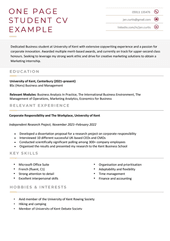
Example of a CV template of one page for students
With clearly titled CV sections, this one page CV for students is straightforward and features this candidate’s most essential background information in a clearly defined order recruiters will easily understand.

Example of a one page CV for experienced professionals
With more experience, your priority as a candidate is to show off your skills and experience to attract a hiring manager’s eye.
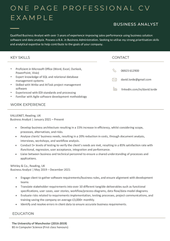
This one page CV for professionals does just that, featuring the candidate’s key skills toward the top, followed by a concise resume of their professional experience.


