Unsure what to include in a CV? We show you everything you need to put on your CV, give you a free template with all the standard CV sections, and even cover what your CV shouldn't have.
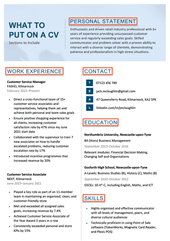
You can click on each of the CV sections listed above to learn more about what you should include in each one. And the example below shows you what to put on a CV outline while also serving as a template you can download and fill in with your own information:
Email | Phone | Address | Social Media (LinkedIn, etc.)
Personal Statement
Enthusiastic and driven retail-industry professional with 6+ years of experience providing unsurpassed customer service and regularly exceeding sales goals. Skilled communicator and problem solver with a proven ability to interact with a diverse range of clientele, demonstrating patience and professionalism to resolve high-stress situations.
Work Experience
Customer Service Manager | FASHO, Kilmarnock February 2021–Present
Direct a cross-functional team of 15+ customer service associates and representatives, helping them set and achieve both personal and team sales goals
Ensure positive shopping experience for all clients, increasing customer satisfaction rate by 47% since my June 2021 start date
Collaborated with the supervisor to train 7 new associates on how to handle escalated problems, reducing customer escalation rate by 17%
Introduced incentive programmes that increased revenue by 20%
Customer Service Associate | NEXT, Kilmarnock June 2019–January 2021
Played a key role as part of an 11-member team in maintaining an organised, clean, and customer-friendly store
Met and exceeded all assigned sales goals, increasing revenue by 7.4%
Achieved Customer Service Associate of the Year Award 3 years in a row
Consistently exceeded personal and store KPIs by 15%
Customer Service Representative | HOUSE OF FRASER, Glasgow October 2016–June 2019
Attended and responded to 74+ customer calls daily regarding product usage, billing issues, and company information
Responded to product/service queries in a courteous manner, enhancing new customer NPS scores by 12%
Maintained 99% positive customer feedback rate
Entered customer orders into Salesforce for products or services
Processed refunds and made billing adjustments with 100% accuracy over 2+ years
Customer Service Intern | HOUSE OF FRASER, Glasgow October 2015–June 2016
Attended and responded to 74+ customer calls daily regarding product usage, billing issues and company information
Responded to product/service queries in a courteous manner, enhancing new customer NPS scores by 12%
Maintained 99% positive customer feedback rate
Entered customer orders into Salesforce for products or services
Education
Northumbria University, Newcastle-upon-Tyne BA (Hons) Business Management Upper second-class honours September 2013–October 2016
Relevant modules: Financial Decision Making, Changing Self and Organisation
Gosforth High School, Newcastle-upon-Tyne A-Levels: Business Studies (B), History (C), Maths (B) September 2010–October 2012
GSCEs: 10 A*–C, including English, Maths, and ICT
Skills
Highly organised and effective communicator with all levels of management, peers, and diverse cultural audiences
Technically proficient in using Point of Sale software (TokenWorks, Magnetic Card Reader, and Plexis POS)
Languages
Native-level English
Fluent in French
Intermediate-level Spanish
Hobbies and Interests
Ukulele playing
Pub quizzes
Attending science-fiction conventions
We’re about to dive deeply into what should be in a CV, but you should also learn how to format your CV to ensure your information is arranged in the way that best fits your level of experience and application purpose.
If writing isn’t your strong suit, consider using a CV maker instead. You’ll have a finished CV in just a few minutes after answering some basic questions about your skills, experience, and education.
The purpose of your CV is to get you interviewed for the role you want. So make it easy for employers to reach you to schedule an interview by putting your contact details at the top of your CV. Here’s the contact information your CV should always include:
your name
a professional email address (your name and/or job title rather than an address that makes you look silly, like [email protected])
your mobile phone number
Optionally, also include:
your postal address (if you don’t want to put your whole address on a CV, you can just add your general area)
your LinkedIn URL
other relevant online profiles (portfolio, website, etc.)
a photo (but only if the employer specifically requests it or you work in a job that’s based by your appearance, such as acting or modelling)
CV icons (to make your contact details easier to find)
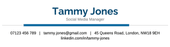
This is an example of what the contact information you put on your CV should look like:
Include your job title with your name and contact details to show you’re qualified.
2. A catchy personal statement
When you’re learning how to write a good CV, figuring out how to get your personal statement right is key. Positioned at the top of your CV, this section (also called a CV ‘About Me’ or CV summary) is meant to get the employer’s attention with your most job-specific experience, achievements, and skills.
So study the job advert and research the company to get a clear idea of what details to highlight in this 3–4 sentence summary. And use exact terms and phrases from the job description to emphasise your suitability for the specific role.
Here’s an example of a CV personal statement customised for a company seeking a ‘creative social media manager’ capable of ‘enhancing audience engagement’:
Put your most marketable skills and experience in your CV’s personal statement.
3. Relevant work experience
If you have some, relevant work experience is the most important information to include on your CV. Employers prefer to bring on experienced new team members that require minimal training. So fill your CV’s work experience section with proof that you’ve mastered your craft by:
giving examples of your skills in action
adding hard numbers wherever possible to show what you can accomplish
This work experience entry uses examples and hard numbers to show the recruiter that the applicant is qualified for the role they’re applying to fill:
Include hard numbers to make your work accomplishments stand out.
Instead of just stating ‘Used organisational skills’, the applicant describes the many tasks (content production schedules, staff supervision, etc.) they successfully juggled. And rather than saying they ‘Boosted TikTok engagement’, the applicant referenced a specific percentage increase (57%).
4. Your education history
Employers want to know what level of education you’ve received. So put these details (if applicable) in your CV’s education section:
university names, locations, and dates attended
degree titles (including honours)
relevant modules studied
secondary school names, locations, and dates attended
A-Levels
GCSEs
This is an example of a properly filled-out education section on a CV:
Use headers to organise your education section for easy skimming.
5. A list of job-specific skills
Putting a bulleted list of skills on your CV shouldn’t be an afterthought. Make this section matter by:
including keywords from the job advert that didn’t fit in the rest of your CV (doing so customises your job application for your target job)
providing specific examples of your relevant expertise (names of software programs, for example)
only listing skills directly related to the role you want
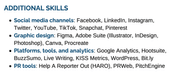
This is a well-written CV skills section:
Use internal headings to make your skills section easy to read if necessary.
6. Optional extra sections
You can create extra sections for any other relevant information you want your target employer to notice on your CV, such as:
The most common extra CV section in the UK is a hobbies and interests section, like this one:
Round out your CV with job-relevant interests.
What not to include in a CV
Curious about what you shouldn’t put on your CV? Here are three things to avoid:
1. Cliches
To maximise your chances of getting called in for a job interview, you need your application to stand out. So using cliched language that appears on most CVs is a bad idea.
Here are examples of words and phrases recruiters are tired of seeing, followed by attention-grabbing CV words that you can use instead:
Responsible for → Trusted with
Detail-oriented → Meticulous
Worked with → Collaborated
If you need help finding unique replacements for cliches on your CV, just do a quick Google search for synonyms.
But only use synonyms that you’re sure improve your CV. It’s better to be clear than use big words that make it obvious you’re sophomoric picking random words from a thesaurus.
2. Irrelevant information
Every detail you put on your CV should be directly related to your ability to perform the job you’re applying for. Even if you’re proud of an achievement or skill, if it’s not relevant to your target role, it won’t connect with the person who reads your CV.
For instance, if you’re applying for a graphic design job, you should list tools like Photoshop and Figma over your guitar shredding skills. (You can always bring that up when a job interviewer asks what you do for fun.)
3. Unusual fonts
If you’re thinking of making your CV stand out by using strange fonts (e.g., handwriting-style script), don’t — or you might stick out for all the wrong reasons.
Your writing software probably offers you many outlandish font choices, which may seem creative but will make your CV hard to read or look tacky. So stick with proven CV fonts like Arial or Georgia to ensure the recruiter can easily see how qualified you are for their job opening.
4. References
Unless the job advert you’re responding to specifically requests them, don’t put references on a CV. Employers typically don’t check references until later in the hiring process, so the space they’d take up on your CV is better filled with descriptions of your skills and achievements.
But if your target employer has asked you to put references on your CV, put them at the end where they won’t distract from your other CV sections.
Frequently asked questions about what goes on a CV
Still unsure what you should include in your CV for a job in the UK? We’ve answered these three common questions about CV content:
A resume is what people in the US and Canada call a CV. So if you’re writing a resume, include the same sections you’d put on your CV, with some slight differences:
A header with your name and contact information
A resume summary (typically called a personal statement on a CV)
Work experience
Education
Skills
Another difference between a resume and a CV is their length. Your resume should be just one page, instead of the customary two pages required for a CV. So there’s typically not space for your CV’s hobbies and interests section.
2. What achievements do you include in a CV?
Put any achievement that shows your target employer you’d excel in the role they’re hiring for on your CV. Such achievements to put on a CV could include successes from your: